2026
THE IRISH TIMES - Earthbound: Clare Langan's film installation gives us a future beyond the end of the world
Artist's work shows humanity's hope and beauty at 'an emotional, poignant moment'
Gemma Tipton, June 2026
Through a doorway off a courtyard that you reach via a lane beyond the busy streets of a hot, dusty Paris is a vast world of ice. Meltwater drips inside a glacial cave, where sharp facets glitter and shadows lurk, masking unknowable depths. Above, light leads outside, where the landscape is made up of jagged fissures in blue, white and grey, stretching to vanishing point.
“I’m holding on to that possibility that there is something that can be done,” says the artist Clare Langan, whose most recent film, Earthbound, imagines the aftermath of a future ice age.
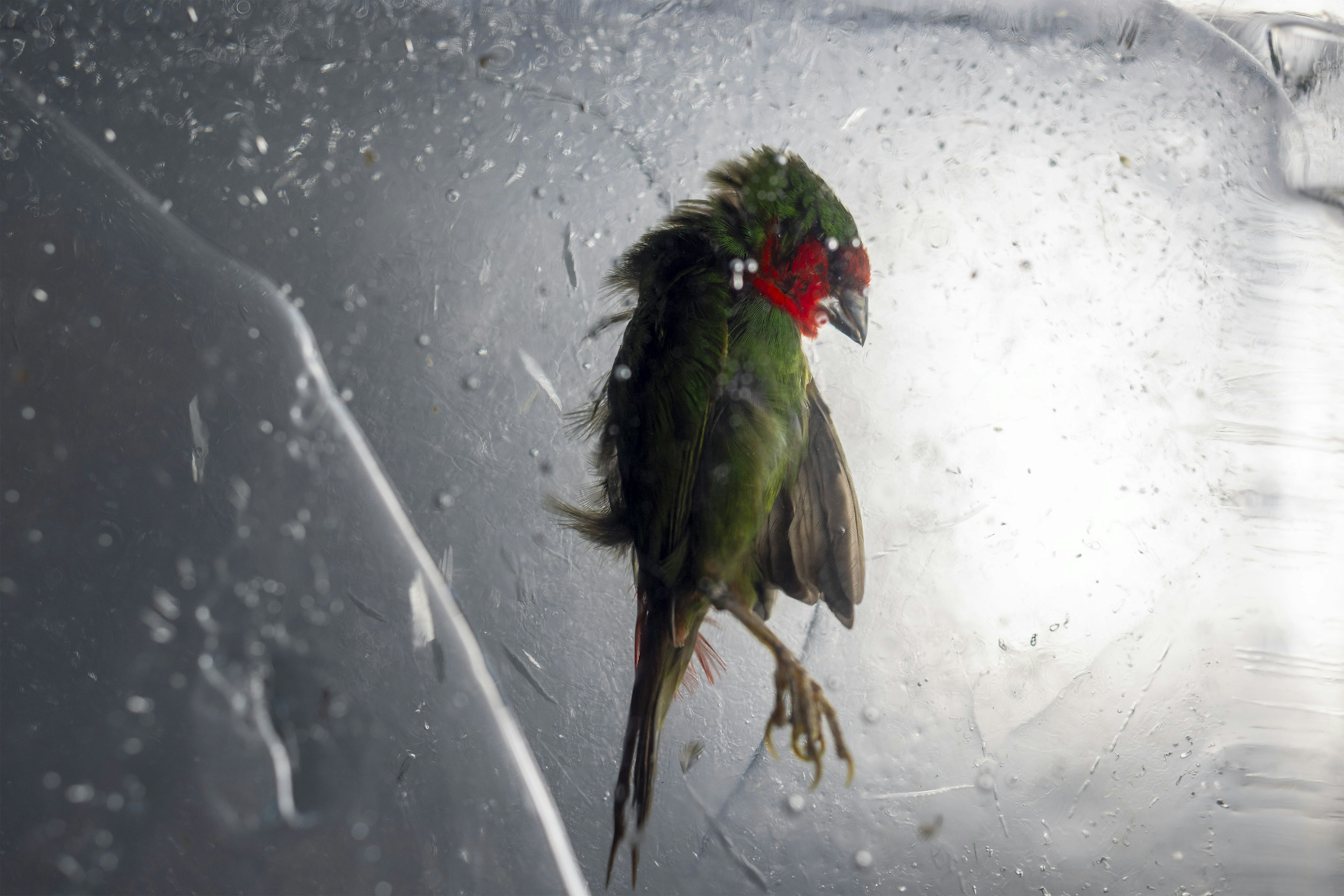
In her four-screen installation, which is premiering at the Irish Cultural Centre in the city, a young woman wakes up, as if from hibernation, to discover the melting glaciers and icefields revealing almost archaeological discoveries: preserved birds and plants, as well as human detritus, the artefacts of our presence through time.
Watching the world during the pandemic led Langan to realise that nature can regenerate. “There was a stillness. Certain insects came back. There was this element of
The term Anthropocene, which entered common usage at the turn of the millennium, is used to characterise our current era, in which humanity has become the primary force of planetary change.
“There are a lot more artists talking about it now,” Langan says. What has altered for her is the inclusion of that possibility for hope.
Made from 1999 onwards, the award-winning artist’s film trilogy Forty Below, Too Dark for Night and The Glass Hour explored the effects of climate change, always with the teasing and intelligent ambiguity that characterises her work.
That trilogy, now in the collection of the Irish Museum of Modern Art, shows, respectively, the impacts of a vast lava flow, encroaching desert and deluge. The works cause ideas to form in your mind, without belabouring or didactic messaging, but there is an element of bleakness to them that’s absent from Earthbound.
“You can’t go round being the horseman of the apocalypse,” Langan says as we talk outside in the spring sunshine of Paris. “As humans we’re resilient, and resilience and hope go hand in hand. You get knocked down, you stand up.”
Alongside the hope there is beauty, as Langan’s awakened figure runs her hand in wonder across the ice, then, reaching for the light, emerges into the whitened world.
The artist has been thinking about fossils emerging from preverbal, prehistorical times, their origins and stories pieced together by scholars.
“I was looking at how much we can preserve, and see and learn from them, and then imagined what it is we’re leaving behind for a future explorer to find, with our plastic that is not going to disappear, and our animals that are already extinct. This is an emotional, a poignant moment.”
Part of the brilliance of Langan’s always haunting work is that balance of her meticulously professional and intelligent approach with her admission of emotion. Her aesthetics are exceptional, but there is far more to her films and installations than surface beauty.
As the four elements of Earthbound play around you, you are immersed in its world but also sense that something is happening just out of view. There are fleeting glimpses, the mesmerisingly exquisite feathers of a frozen bird, an umbrella, a plastic bottle, a light bulb, held as if in amber but instead in ice.
“The human character adds a sense of relationship and emotion. It signifies our place in the world,” Langan says. “The cave is claustrophobic, but then she’s tiny in the landscape.”
Born in Dublin and now based in Co Kerry, Langan studied at the National College of Art and Design before a Fulbright scholarship brought her to complete a film course at New York University. Returning to Ireland, she worked in the art department on films that included Braveheart, Far and Away and Some Mother’s Son before realising that art was where her true passion lay.
“It was an amazing education, because I saw how teams worked together,” she says.
She still has close friends from those days, and a core collaborator from the outset has been cinematographer Robbie Ryan, whose film credits include Poor Things and The Favourite. “A producer introduced us. He was this enthusiastic, experimental guy. We bought a Bolex [camera] and used my hand-painted filters in front of the lens.
“I’m lucky,” Langan says, “that he still wants to come on my shoots. He calls them my ‘boot camps’, because they are really hard.”
She laughs, describing the process of filming in Iceland, the tiny team trekking up the glacier and into the ice cave, everyone helping to lug the equipment.
“Robbie is brilliant, and that’s the thing about film: it’s collaborative. Everyone brings their things to the table.”
In this instance, “everyone” also includes the editor Adam Finch, who is best known for his work with the British artist and film-maker Isaac Julien; the composers Gyda Valtýsdóttir and Úlfur Hansson; and the curator Heinz Peter Schwerfel.
Back in the darkened exhibition space at the Irish Cultural Centre, a small bubble of ice looks like an alien face, another a sleeping creature. A whole world of wonder appears in a single droplet of water. The human figure holds up a torch, or perhaps it’s a smartphone.
Perspectives shift and scale alters. The figure climbs; she drinks the meltwater, then drinks in the daylight. Sounds move about. Patterns in the ice look like hieroglyphics, their hues set against the warm tones of living skin. A handprint could be a future fossil being formed. We cannot help but leave a trace.
The red silk of the figure’s cloak is echoed in the feathers of a bird. Later she will wave it, like a beacon – or perhaps a warning that humanity is coming back.
While Langan filmed on location in Iceland, she also created ice sculptures back at her home studio, where she has two freezers, one for food and one for some of the subjects of her work.
“That one can be a bit of a horror show,” she says, smiling, and I’m reminded that the late artist and film-maker David Lynch always said he had something similar going on in his freezer at home.
“We find what drives us,” Langan says. “It changes over time, but I am very immersed in what I do.”
She is driven but knows herself well enough to realise when to leaven things. When not on location, she spends mornings intensely working, while afternoons bring walks, which she describes as “my balancing point”.
The Ireland Invites programme put together by the Irish Museum of Modern Art, the Hugh Lane and Culture Ireland brings curators to Ireland, and the biennial EVA International invites an international guest curator every two years, but Ireland is nonetheless a small country, geographically on the periphery of Europe.
Showing in Paris gives Langan the chance to connect with larger networks. She has already represented Ireland at international biennales and this is work that deserves to be seen on the widest of stages.
Since Forty Below, more than 25 years ago, her work has had an increasing urgency, and the conversations it creates are ones with which more and more artists and writers are becoming involved.
“It is shocking and sad,” Langan says, considering the state of the planet. “And there is so much going on you would really feel like this is the end of it. But I think you cannot. That’s part of the human spirit. It’s part of the soul.”
Earthbound is on show daily from 2pm to 6pm at the Irish Cultural Centre/Centre Culturel Irlandais, in Paris, until Tuesday, June 30th. Ice Fossil, Bird 1, a still from the film, is included in this year’s RHA Annual Exhibition until August 9th. A series of lightboxes from the film are on view at galerie-beckers.com
In The Picture: Artist Clare Langan's Earthbound at CCI Paris
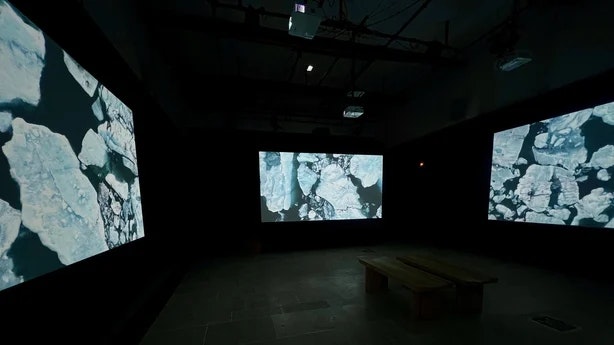
Currently showing at The Centre Culturel Irlandais in Paris, celebrated artist Clare Langan's Earthboundis a new multiscreen film installation, accompanied by a series of large-scale photographs.
Earthbound is a visually arresting, multi -screen cinematic installation set in a world transformed by the aftermath of a future Ice Age and what reawakens as the ice recedes.
Read full review here: https://www.rte.ie/culture/2026/0607/1578287-in-the-picture-artist-clare-langans-earthbound-at-cci-paris/
2024
Festival Cinedans in Eye highlights the postcolonial pain on an African rubbish dump: 'Dancing? Here? First clean up your mess!' by Fritz de Jong
'Trees on a pitch-black beach':
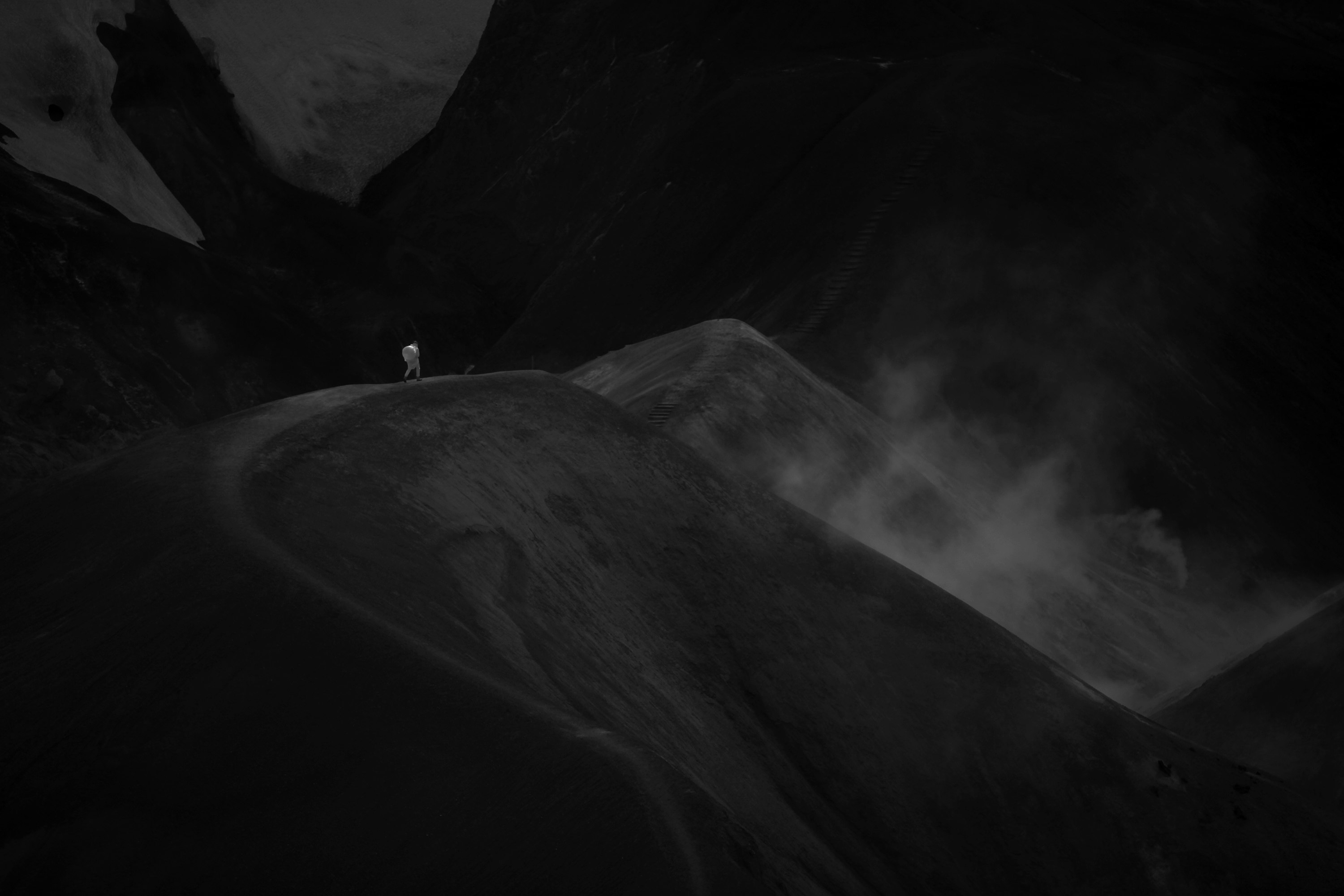
A completely different atmosphere is evoked in the program part Iceland in the Eye. The key words here are tranquil and alienating. This certainly applies to The Heart of a Tree (2020), shot in beautiful black and white. Three human figures in white suits descend into a glacier landscape. It could just be another planet. From a great distance, the camera follows the movements of the cautiously moving group, which seem to harvest oxygen in billowing dust bags.
Later the camera comes closer and we see the trio planting trees on a pitch-black beach. A sparse composition by the late Jóhann Jóhannsson emphasizes the desolate, yet hopeful atmosphere.
Read full article here: https://www.parool.nl/kunst-me...
2023
The Irish Examiner: Clare Langan at Castletownbere gallery, 'There’s a great stillness involved in taking photographs' by Marc O' Sullivan.
Only an artist as inventive as Clare Langan would find commonality behind the ancient beehive huts on Skellig Michael and the contemporary Bur Khalifa building in Dubai. Both feature in her 15-minute experimental film, The Floating World.Langan used infrared film when shooting on Skellig Michael, which gives the impression that snow is falling on the monastic settlement. In Dubai, she filmed the 830-metre-high Bur Khalifa building and other skyscrapers shrouded in mist. Both contribute to the dream-like quality of The Floating World, which, like much of Langan’s work, is an enchanting synthesis of sound and vision.
Read full review here: https://www.irishexaminer.com/lifestyle/artsandculture/arid-41198221.html
2022
Gemma Tipton (Irish Times) reviews 'Living Canvas' at Wilton Park. Europe’s largest dedicated art screen has popped up in Dublin. What’s going on?
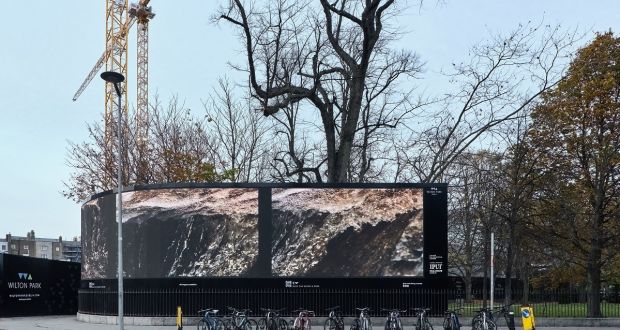
Clare Langan’s River, on the screens at Wilton Park in Dublin, shows water shot in extreme close-up and extreme slow motion, which becomes hypnotic.
"Maybe it’s the cranes, but I’m thinking of Blade Runner: those vertiginous cityscapes where vast screens present a glittering array of faces, all enticements to desire. It’s no surprise to find that director Ridley Scott cut his filmmaking teeth in advertising. At its best, advertising creates hugely memorable images, but commerce always wants its cut.
So, when I first came across the huge digital screen showing contemporary art at Wilton Park in Dublin, my first thought was: what are they selling? We are so used to everything having a commercial imperative that without one, Living Canvas seems like an outlier. That’s because the screen is solely dedicated to art, and is the first of its kind at this scale in Europe. It is also the second only in the world, the other being at the M+ museum in Hong Kong."....
Read full article here: A very big space for art at Wilton Park (irishtimes.com)
2021
Christmas in Confidence: Barbara Polla (Switzerland), December 23, 2021
Flight from the City: A mother and daughter swim. I've watched this video by Clare Langan, with the mysterious title, hundreds of times. I love this work for many reasons: its hypnotic magnetism, the quality of the images, the link to the music, its extreme softness, the slowness, the water of course - the water from which we come, the water that constitutes us, crosses us, the amniotic water… and above all, I love it for the trust forged between the two women, a mother and a child, one imagines. One human being's absolute trust in another human being is a rare and beautiful reality. The total letting go of the child in this liquid space-time, dreamlike, on the body of the woman, guided by her, carried by her, held, let go, eyes closed, eyes in the eyes too, for a moment, until the adult gently separates from the child, throwing her into the world, once again.
It is this magical trust that the child has for the mother that allows it to definitively appropriate this feeling: then, trust in the other becomes self-confidence. The respect that emanates from the adult, the attention paid to the child, the physical tenderness, are transformed into respect and tenderness that the then grown-up child will be able to give other humans. I like this work because the apparent absence of narration is actually nourished by a psychological depth, even philosophical, a reflection on existence, on the future of the child, the disappearance of previous generations, the promise of other generations, on transmission.
Transmitting trust, in this Christmas 2021, is more important than ever, it seems to me, don’t you think so? The video is currently running in a loop in the gallery, until January 31st, 2022. Do not hesitate to come and be inspired by this wonder, come with your children – and until then, to you who read me, thank you – and let us all offer, in this vigil of gifts, one to the other, an extra confidence.
2015
Aidan Dunne: Visual Art round-up: Worlds on the brink and cosmic explorations (irishtimes.com)
2014
Island Odyssey, Art and Context by Joan Fowler: Brendan-Earley_Gravitational-Waves’_Joan-Fowler_Art-and-Context_March-2014_©All-rights-reserved.pdf (motherstankstation.com)